
Castellammare di Stabia.
Castellammare di Stabia pairs a working Gulf of Naples waterfront with the remains of Roman villas on the Varano plateau. Its own archaeology deserves time: Stabiae’s residential rooms, gardens and painted decoration tell a different story from a quick excursion to the streets of Pompeii.
Photo credits1
- Depicts: Castellammare di StabiaCastellammare di Stabia 3. Author: Mentnafunangann. Credit: Own work. License: CC BY-SA 3.0 (https://creativecommons.org/licenses/by-sa/3.0). Source: https://commons.wikimedia.org/wiki/File:Castellammare_di_Stabia_3.JPGCropped to fit the display.
Make your way to Castellammare di Stabia
Choose a tool and your dates to check the options for your trip.
More ways to explore
- Country
- Italy
- Currency
- EUR
- Time zone
- Europe/Rome
Castellammare di Stabia pairs a working Gulf of Naples waterfront with the remains of Roman villas on the Varano plateau. Its own archaeology deserves time: Stabiae’s residential rooms, gardens and painted decoration tell a different story from a quick excursion to the streets of Pompeii.
Begin with the seafront and the city, then plan the climb to the villas and the Quisisana museum as a separate part of the day. The town also offers a practical connection to the Sorrento peninsula, but it is not simply another name for Sorrento. Port, railway station and hillside cultural sites need distinct directions.
When to go
The archaeological park uses a winter calendar from 15 October to 15 March, with earlier last admission than in summer. The Stabiae villas and museum normally close on Tuesdays, so arrange that part of a short stay before choosing other excursions. Outdoor ruins, a waterfront walk and the indoor museum provide different options as conditions change. Summer requires shade and water for the exposed archaeological areas; shorter winter daylight makes the return from hillside sites more important than fitting one more destination into the day.
Getting there
The archaeological park directs rail visitors to the EAV Circumvesuviana Naples–Sorrento line, getting off at Castellammare di Stabia, then continuing locally. For NLG sea travel, the published ticket-office location is Piazzale Incrociatore San Giorgio inside the port. Follow the instructions for your actual departure rather than selecting a generic marina pin. NLG publishes a Castellammare–Capri route page with period-specific and Sorrento-related notes; confirm where your particular journey begins and any connection before committing to it. Public route information does not establish seats or operation on every date.
Getting around
The park’s Artebus route 3 links city stops with Quisisana, Villa Arianna and Villa San Marco; it is separate from the shuttles starting at Pompeii for other sites. The published Stabia service has winter and summer schedules and no Tuesday operation. Seats are limited and the stated vehicle has no wheelchair boarding platform, so arrange a suitable alternative if required. Check the last return carefully: a final collection run is not an opportunity to begin visiting after the site’s last entry. Local EAV buses are another connection to examine for your address.
Local food
Look for biscotti di Castellammare, traditionally sold in elongated shapes or small rings and associated with distinctive blue paper wrapping. Campania’s product record describes flour, sugar, natural flavourings and a naturally leavened dough. It also records the local custom of dipping them in Acqua della Madonna. That culinary tradition is not a present-day guarantee that a particular public spring is available or safe to drink: use current local information. Check the ingredients on the actual packet, particularly for dietary restrictions.
What to see
Villa San Marco and Villa Arianna show how elite Roman households arranged rooms, baths, porticoes and outlooks above the gulf. Arianna takes its modern name from a mythological painting found in a dining room. At the Reggia di Quisisana, the Libero D’Orsi Archaeological Museum brings together wall paintings, marble furnishings, pottery and bronze objects from the Stabian territory. Its displays connect excavated objects with their original settings. Add the Cassa Armonica on the waterfront for a contrasting piece of the city’s more recent architectural identity.
Towns and neighbourhoods
The city centre and seafront form the everyday urban base, with the harbour at the water and routes inland towards Varano. The villas lie on that plateau, while the Quisisana palace and museum occupy a different hillside location. Do not treat a museum visit as automatically included in a walk around the villa ruins. Pompeii, Vico Equense and Sorrento are separate destinations for another outing. When comparing accommodation, check whether the address serves the rail station, your actual embarkation or the uphill archaeological visits.
Coast and outdoors
The seafront is a useful outdoor option for a gentle walk and views over the gulf, with the Cassa Armonica and public gardens as landmarks. A working port and a leisure promenade do not themselves identify an approved swimming area: follow the posted access and bathing notices at the beach you choose. For a mountain day, check the current route and transport before heading towards Faito. EAV’s official timetable page checked on 29 October 2026 states that the Faito cable car is closed; do not plan to ascend or descend by it.
Where to stay
A central base near your rail or sea departure makes repeated regional trips simpler, while a hillside property can suit a stay focused on the villas and palace. Compare the final walking approach rather than judging distance only on a map. Ask the host about stairs, a late return, parking and the exact stop or drop-off. If the plan combines a morning boat with an afternoon museum, allow for two different access routes and keep luggage arrangements explicit; the port is not the museum’s entrance.
Useful before you go
Check each Stabiae site’s opening and ticket conditions separately: the villas and museum do not have identical admission arrangements. At excavations, stay on the permitted route and avoid touching painted walls or climbing ancient structures. The museum’s access information and the transport vehicle’s accessibility are separate questions. Older tourism descriptions still mention a quick Faito cable-car ride or thermal treatments; neither establishes a service operating today. Use the current operator or venue notice, and retain a city or museum alternative when an outing is unavailable.
Good to know before you go
Are the Stabiae villas inside Pompeii?
No. Villa Arianna and Villa San Marco are at Castellammare di Stabia, on the Varano plateau. They need their own visit and transfer.
Is Quisisana the same place as Villa San Marco?
No. Quisisana is the palace housing the Libero D’Orsi museum. The Roman villas are separate archaeological sites.
Can I take the Faito cable car now?
The official EAV timetable page checked on 29 October 2026 states that it is closed. Check for an actual reopening notice before planning a ride.
Does the Stabia Artebus run on Tuesdays?
The park’s published timetable says it does not, matching the usual Tuesday closure of the Stabiae sites.
Is the archaeological shuttle wheelchair accessible?
The park states that the vehicle lacks a wheelchair boarding platform. Discuss a suitable alternative and the site’s own access arrangements in advance.
Sources & references
These references support the guide. Confirm opening hours, access and travel services before you go.
- 01Pompeii Archaeological Park — Stabiae villas and Varano
- 02Pompeii Archaeological Park — current Quisisana museum and local approach
- 03Pompeii Archaeological Park — palace and historical setting
- 04Pompeii Archaeological Park — winter calendar, Tuesday closures and admission distinctions
- 05Pompeii Archaeological Park — rail approach to Stabiae
- 06Pompeii Archaeological Park — Artebus route 3 and accessibility limits
- 07EAV — current Faito cable-car closure, checked 29 October 2026
- 08NLG — Castellammare port ticket office
- 09NLG — period-specific Capri route notes; no availability test
- 10Campania Agriculture — Castellammare biscuits
- 11National Association of Thermal Municipalities — waterfront architecture; stale service claims excluded
- 12Local hospitality association ASTAR — city waterfront and regional context
Where could the journey go next?
More guides in Italy. Compare the places and check actual connections before combining stops.

Torre Annunziata
Torre Annunziata is a working coastal town beneath Vesuvius, with the Roman remains of Oplontis embedded in its modern streets. Its main archaeological visit is the Villa of Poppea, a richly decorated residence buried in the eruption of AD 79. The name reflects an attribution to Poppaea Sabina or her family, rather than an ownership claim that can be stated with certainty.
Get to know the place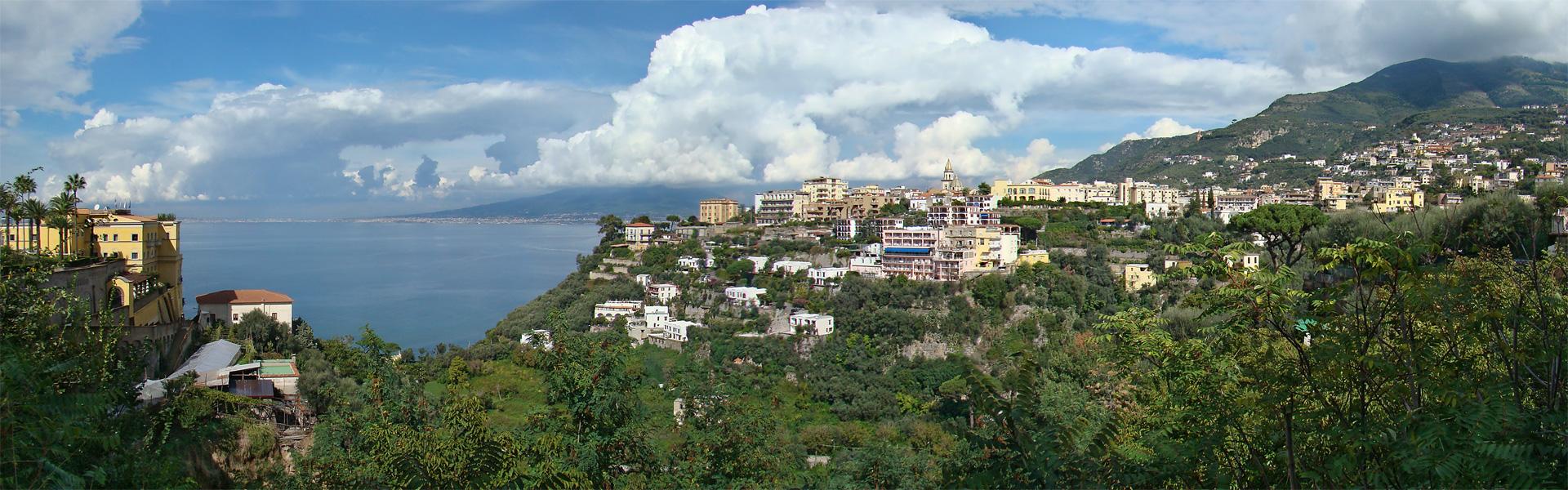 Area overview: Vico Equense
Seiano / Vico Equense
Seiano combines a hillside village with Marina Aequa, a small harbour and bathing shore within the municipality of Vico Equense. The upper streets and the waterfront have different rhythms: church bells and village lanes above, boats, beaches and seaside tables below. The destination sits on the Gulf of Naples side of the Sorrento Peninsula.
Get to know the place
Positano
Positano is built vertically, with houses and lanes descending towards a small waterfront. Its appeal comes from moving slowly between viewpoints, shops, church and beach. A hotel with a magnificent panorama can also mean a steep daily climb, so access matters as much as the view.
Get to know the place
Piano di Sorrento
Piano di Sorrento offers a different view of the peninsula: a town above the Gulf of Naples, with Villa Fondi’s gardens and an archaeological museum looking across the water. Down at Marina di Cassano, boats, small businesses and bathing areas give the shoreline its own identity.
Get to know the placePhoto credits4
- Depicts: Torre AnnunziataAncient Pompeii - Boscoreale - Castellammare - Pompei - Torre Annunziata - Vesuvius - Sorrento - Capri - Panorama. Author: Norbert Nagel. Credit: Own work. License: CC BY-SA 3.0 (https://creativecommons.org/licenses/by-sa/3.0). Source: https://commons.wikimedia.org/wiki/File:Ancient_Pompeii_-_Boscoreale_-_Castellammare_-_Pompei_-_Torre_Annunziata_-_Vesuvius_-_Sorrento_-_Capri_-_Panorama.jpgCropped to fit the display.
- Area image: Vico Equense — Area overview: Vico EquenseCampania VicoEquense tango7174. Author: Tango7174. Credit: Own work. License: CC BY-SA 4.0 (https://creativecommons.org/licenses/by-sa/4.0). Source: https://commons.wikimedia.org/wiki/File:Campania_VicoEquense_tango7174.jpgCropped to fit the display.
- Depicts: PositanoPositano Sunset. Author: JeCCo. Credit: Own work. License: CC BY 4.0 (https://creativecommons.org/licenses/by/4.0). Source: https://commons.wikimedia.org/wiki/File:Positano_Sunset.JPGCropped to fit the display.
- Depicts: Piano di Sorrento
