
Sweden.
Sweden combines lively cities with long stretches of forest, lake country and island coastline. A trip can centre on Stockholm’s museums, Gothenburg’s west-coast setting, Malmö and Skåne, or a quieter region where the landscape sets the pace. These are different holidays: choose a manageable part of the country before adding a distant northern extension.
Photo credits1
A little closer to Sweden
Geography, regions and practical details from the country guide. Go straight to a chapter, or browse every destination below.
Go straight to the destinationsSweden combines lively cities with long stretches of forest, lake country and island coastline. A trip can centre on Stockholm’s museums, Gothenburg’s west-coast setting, Malmö and Skåne, or a quieter region where the landscape sets the pace. These are different holidays: choose a manageable part of the country before adding a distant northern extension.
For a ferry-based itinerary, the arrival port matters as much as the country name. A southern Baltic landing, a west-coast crossing and a Stockholm-area terminal lead to different onward journeys. Combine a few nearby destinations with time for local food, walking and water, while treating northern mountain travel and outer-island connections as plans that need their own preparation.
Landscape and trip style
The country stretches from southern agricultural and coastal landscapes to a far north with Arctic and subarctic conditions. Forests, lakes and archipelagos are important parts of the journey between cities. The west coast around Bohuslän differs from the Baltic islands of Gotland and Öland and from the inland lake regions. Distance and season matter together: spring conditions in Skåne do not describe a northern mountain route.
Regions to explore
Stockholm is a city-and-archipelago base; Gothenburg introduces West Sweden and Bohuslän, while Malmö and Trelleborg connect naturally with Skåne. Halland offers another stretch of the west coast, and Blekinge includes Karlskrona and Karlshamn. Gotland and Öland are distinct Baltic islands. Dalarna and Värmland give inland alternatives, while the High Coast, Västerbotten and Swedish Lapland extend the journey north. These are travel regions, not a single administrative classification.
Language
Swedish is the principal language. Finnish, Meänkieli, Yiddish, Romani and Sámi are recognised national minority languages, and Swedish Sign Language also has a special position. Many people speak English, making everyday visitor communication relatively straightforward. Keep local place names and addresses in their Swedish spelling for stations, tickets and navigation: the letters å, ä and ö are part of the alphabet, not optional decoration.
Money
Sweden uses the Swedish krona, SEK, rather than the euro. Visa and Mastercard are widely accepted, and many businesses prefer or require card payment. Carry a compatible chip-and-PIN card and consider a backup payment method. Swish normally requires a Swedish bank account and personal identity number, so most visitors cannot use it as a substitute for a bank card. Check your own bank’s conversion charges when comparing prices.
Culture and food
Fika is time set aside for coffee and a baked treat, often with company; a cinnamon bun is a familiar choice. Midsummer brings shared meals and dancing around a leafy pole, with local public celebrations available to visitors. Sámi culture is a living Indigenous culture with languages, music, craft and contemporary livelihoods. Choose Sámi-led interpretation when exploring Sápmi, rather than reducing the region to scenery or reindeer photographs.
When to go
Southern coastal conditions and northern winters differ substantially. Summer brings long evenings and more seasonal boat trips, while the far north experiences the midnight sun. Winter has short daylight and suitable snow activities in the regions where conditions support them; snow and northern lights are never a countrywide guarantee. Spring and autumn can suit city-and-nature combinations. Check holiday calendars: Midsummer can reduce shop and museum hours even during the busiest travel season.
Getting there
Arlanda serves Stockholm and Landvetter serves Gothenburg; Copenhagen Airport in Denmark is also a practical rail gateway to Malmö. Ferry directions must remain operator-specific. In Stockholm, Tallink Silja uses Värtahamnen and Viking Line uses Stadsgården. At Trelleborg, TT-Line pedestrians report to Central Station, while Stena pedestrians use Hamngatan 9. Check the exact terminal and required travel documents before arranging an airport or railway connection.
Getting around
Trains and long-distance coaches connect major places, while regional systems handle many local journeys. SL serves Stockholm, Västtrafik the Gothenburg and West Sweden area, and Skånetrafiken Skåne. Their tickets are not a universal national pass. Island boats can have additional ticket conditions and seasonal schedules. When staying in a village or on an island, work backwards from the final local connection rather than booking only the main train.
Planning your stay
The right of public access brings responsibilities, not permission to camp or drive everywhere. Respect cultivated ground and the private space around homes; there is no universal seventy-metre boundary. A small tent stay may be possible with conditions, but motor vehicles are excluded and protected areas have their own restrictions. Berry and mushroom picking is not automatically banned in every reserve: check that area’s rules and protected species before collecting anything.
Good to know before you go
Does Sweden use euros?
No. The currency is the Swedish krona, SEK. Do not assume a shop will accept euro cash.
Can tourists rely on Swish?
Usually not: it requires Swedish banking and identification arrangements. A compatible payment card is more practical.
Is the right of public access the same everywhere?
No. Private residential space, cultivated land, protected areas and local rules impose limits. It also does not authorise motor vehicles on natural land.
Does one ticket cover all Swedish public transport?
No. Regional networks and intercity operators have different products. Check the whole route, including any airport or island boat segment.
Can I see the midnight sun in southern Sweden?
The south has long summer evenings, but the midnight sun belongs to the far north. Choose the place and season specifically for that experience.
Sources & references
These references support the guide. Confirm opening hours, access and travel services before you go.
- 01Visit Sweden — travel regions
- 02Visit Sweden — regional climate and daylight
- 03Institute for Language and Folklore — languages in Sweden
- 04Örebro University — English and Swedish alphabet
- 05Visit Sweden — visitor payments
- 06European Commission — Swedish currency
- 07Visit Sweden — fika
- 08Nordiska Museum — Midsummer traditions
- 09Visit Sweden — Sámi-led culture
- 10Visit Sweden — regional transport networks
- 11Visit Sweden — airport geography
- 12Visit Sweden — intercity rail planning
- 13Swedish Environmental Protection Agency — camping and vehicle limits
- 14Swedish Environmental Protection Agency — protected-area collecting rules
- 15Swedish Environmental Protection Agency — variable residential privacy zone
- 16Ports of Stockholm — Värtahamnen
- 17Ports of Stockholm — Viking terminal
- 18TT-Line — Trelleborg pedestrian check-in
- 19Stena Line — Trelleborg pedestrian check-in
- 20Gothenburg tourism — holiday opening changes
Find your place in Sweden
Open the guides, get a feel for the differences between places, and find the ones that fit your plans.

Gothenburg
Gothenburg, Göteborg in Swedish, is a west-coast city shaped by its river, harbour and appetite for seafood. Canals and tram lines connect a compact centre with shopping courtyards, museums and neighbourhood cafés. A good first visit leaves space for fika, the Swedish coffee break, instead of treating the city as a queue of landmarks.
Read the field guide
Halmstad
Halmstad sits on Sweden’s west coast where the Nissan River reaches the sea. Its compact centre combines art, riverside walks and traces of a fortified Danish past, while Tylösand supplies the broad beach landscape associated with summer in Halland. The two experiences are close enough to combine, but the beach is a separate outing from a stroll around the central squares.
Read the field guide
Kapellskär
Kapellskär is a working ferry port on Rådmansö in the Roslagen coastal region, east of Norrtälje. It is geographically separate from central Stockholm’s ferry terminals. Its visitor appeal comes from the contrast between ships crossing the Baltic and the wooded shores of neighbouring Riddersholm, where a stopover can become a quiet nature break.
Read the field guide
Karlshamn
Karlshamn is a small Blekinge coastal town with merchant houses, cobbled streets and an archipelago beyond its guest harbour. Its history combines shipping, emigration and local industry, while the present-day waterfront makes an easy place to slow down between a museum visit and a café stop. The river and coast are part of everyday town life rather than distant excursions.
Read the field guide
Karlskrona
Karlskrona grew around a planned naval city on the Blekinge coast. Its broad squares, dockyard heritage and surviving late seventeenth-century layout explain its UNESCO World Heritage recognition. Water separates and connects its neighbourhoods: the monumental centre on Trossö has a different character from the modest wooden houses of nearby Björkholmen.
Read the field guide
Malmö
Malmö makes a varied city break beside the Öresund: old-town squares, contemporary waterfront architecture, parks and a food scene shaped by many communities. Walkable neighbourhoods make it possible to build a day around short discoveries, with a café or gallery between larger sights. The city rewards time on land even when it first appears on an itinerary as a ferry connection.
Read the field guide
Nynäshamn
Nynäshamn is a coastal town south of Stockholm where a working ferry port sits beside a smaller world of guest-harbour stalls, wooded shorelines and bathing coves. It is worth keeping a few hours for the town itself rather than treating every stop as a transfer. The promenade and nearby nature make a satisfying contrast to a long crossing.
Read the field guide
Stockholm
Stockholm is a city of distinct island neighbourhoods, where a walk can move from old streets to a broad waterfront and then a wooded museum district. Its appeal lies in that combination: royal and civic history, everyday cafés, ambitious collections and water used for both travel and leisure. Choose a few connected areas rather than trying to cross the entire city in one day.
Read the field guide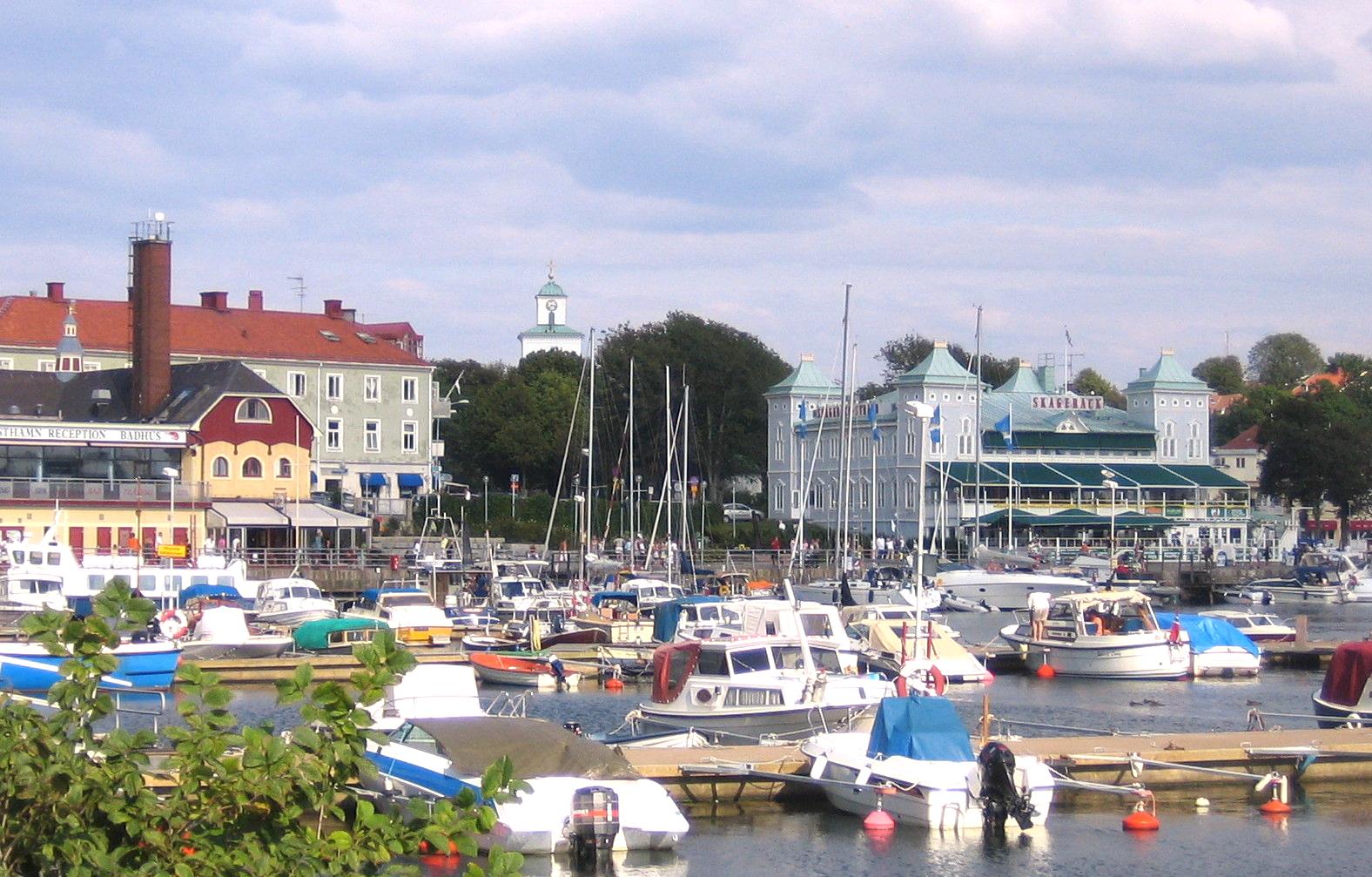
Strömstad
Strömstad is a small Bohuslän coastal town near the Norwegian border, with fishing history, harbour life and a landscape of islands beyond the waterfront. It makes a useful base for both a town break and the Koster archipelago. Give the centre time of its own: the river, local museum and former railway buildings tell a different story from the beaches offshore.
Read the field guide
Trelleborg
Trelleborg is Sweden’s southernmost city, a busy ferry gateway with a walkable centre and the farmland of Söderslätt behind it. It rewards a stop beyond the crossing: a reconstructed Viking fortress, local-history collections and sculpture give the town more texture than the view from a vehicle queue suggests. The harbour is a working transport landscape, not one continuous leisure promenade.
Read the field guide Local overview of Umeå
Umeå
Umeå is a northern Swedish city beside the Ume River, with contemporary art, university life and birch-lined streets. The riverfront makes a natural starting point: combine a museum with a walk and leave another part of the day for cafés or the cultural centre. Forest and lake outings are close enough to complement the city rather than replace it.
Read the field guide
Visby
Visby is the historic town on Gotland’s west coast, where medieval walls frame lanes, merchant buildings and church ruins. Its UNESCO recognition concerns the preserved Hanseatic townscape, not simply one monument. Give the old streets time: a museum visit, a quiet garden and an evening by the sea reveal more than a quick photograph beside a gate.
Read the field guide
Ystad
Ystad combines a working Baltic ferry port with a small-town centre of colourful houses, cobbled lanes and gardens. You can move from a museum to a café and then towards the coast without making the harbour your whole visit. The town’s association with Henning Mankell’s fictional detective Kurt Wallander adds another way to explore familiar-looking streets.
Read the field guidePhoto credits13
- Depicts: GothenburgGöteborg 2503 stitch (28573994096). Author: Bengt Nyman from Vaxholm, Sweden. Credit: D81_2503_stitch. License: CC BY 2.0 (https://creativecommons.org/licenses/by/2.0). Source: https://commons.wikimedia.org/wiki/File:G%C3%B6teborg_2503_stitch_(28573994096).jpgCropped to fit the display.
- Depicts: HalmstadHalmstad Nissan01. Author: Boberger . Photo: Bengt Oberger. Credit: Own work. License: CC BY 3.0 (https://creativecommons.org/licenses/by/3.0). Source: https://commons.wikimedia.org/wiki/File:Halmstad_Nissan01.JPGCropped to fit the display.
- Depicts: KapellskärKapellskär harbour from MS Finnfellow. Author: junafani. Credit: Own work. License: CC BY-SA 3.0 (https://creativecommons.org/licenses/by-sa/3.0). Source: https://commons.wikimedia.org/wiki/File:Kapellsk%C3%A4r_harbour_from_MS_Finnfellow.JPGCropped to fit the display.
- Depicts: KarlshamnKarlshamntorg1. Author: Entheta. Credit: Own work. License: CC BY-SA 3.0 (https://creativecommons.org/licenses/by-sa/3.0). Source: https://commons.wikimedia.org/wiki/File:Karlshamntorg1.jpgCropped to fit the display.
- Depicts: KarlskronaFredrikskyrkan1. Author: Sendelbach ( talk ). Credit: Own work. License: CC BY-SA 3.0 (https://creativecommons.org/licenses/by-sa/3.0). Source: https://commons.wikimedia.org/wiki/File:Fredrikskyrkan1.jpgCropped to fit the display.
- Depicts: MalmöThis image was produced by me, David Castor ( user:dcastor ). The pictures I submit to the Wikipedia Project are released to the public domain. This gives you the right to use them in any way you like, without any kind of notification. This said, I would still appreciate to be mentioned as the originator whenever you think it complies well with your use of the picture. A message to me about how it has been used would also be welcome. You are obviously not required to respond to these wishes of mine, just in a friendly manner encouraged to. (All my photos are placed in Category:Images by David Castor or a subcategory thereof.)Wikimedia CommonsCC0Malmö–flygbild 06 september 2014. Author: This image was produced by me, David Castor ( user:dcastor ). The pictures I submit to the Wikipedia Project are released to the public domain. This gives you the right to use them in any way you like, without any kind of notification. This said, I would still appreciate to be mentioned as the originator whenever you think it complies well with your use of the picture. A message to me about how it has been used would also be welcome. You are obviously not required to respond to these wishes of mine, just in a friendly manner encouraged to. (All my photos are placed in Category:Images by David Castor or a subcategory thereof.). Credit: Own work. License: CC0 (https://creativecommons.org/publicdomain/zero/1.0/). Source: https://commons.wikimedia.org/wiki/File:Malm%C3%B6%E2%80%93flygbild_06_september_2014.jpg
- Depicts: NynäshamnNynäshamn omgiv. Author: Pewee. Credit: Own work. License: CC BY 3.0 (https://creativecommons.org/licenses/by/3.0). Source: https://commons.wikimedia.org/wiki/File:Nyn%C3%A4shamn_omgiv.jpgCropped to fit the display.
- Depicts: StockholmMunkbroleden with Kornhamstorg at Gamla Stan, Stockholm, Sweden 01. Author: OleNeitzel. Credit: Own work. License: CC BY 4.0 (https://creativecommons.org/licenses/by/4.0). Source: https://commons.wikimedia.org/wiki/File:Munkbroleden_with_Kornhamstorg_at_Gamla_Stan,_Stockholm,_Sweden_01.jpgCropped to fit the display.
- Depicts: StrömstadSödra Hamnen, Strömstad. Author: jorchr. Credit: Self-photographed. License: CC BY-SA 3.0 (https://creativecommons.org/licenses/by-sa/3.0/). Source: https://commons.wikimedia.org/wiki/File:S%C3%B6dra_Hamnen,_Str%C3%B6mstad.jpgCropped to fit the display.
- Depicts: TrelleborgTrelleborg, Springbrunnen und Turm (2008-07-27). Author: Klugschnacker. Credit: Own work. License: CC BY-SA 3.0 (https://creativecommons.org/licenses/by-sa/3.0). Source: https://commons.wikimedia.org/wiki/File:Trelleborg,_Springbrunnen_und_Turm_(2008-07-27).JPGCropped to fit the display.
- Area image: Ume älv viewed from Tegsbron (E4) in Umeå, Sweden — local overview of Umeå.Ume alv in Umea. Author: Tage Olsin. Credit: Self-photographed. License: CC BY-SA 2.0 (https://creativecommons.org/licenses/by-sa/2.0). Source: https://commons.wikimedia.org/wiki/File:Ume_alv_in_Umea.jpgCropped to fit the display.
- Depicts: Visby0522Visby domkyrka. Author: L.G.foto. Credit: Own work. License: CC BY-SA 4.0 (https://creativecommons.org/licenses/by-sa/4.0). Source: https://commons.wikimedia.org/wiki/File:0522Visby_domkyrka.jpgCropped to fit the display.
- Depicts: YstadYstad stortorget. Author: Mickaël Delcey ( Silverkey ). Credit: Own work. License: CC BY-SA 3.0 (https://creativecommons.org/licenses/by-sa/3.0). Source: https://commons.wikimedia.org/wiki/File:Ystad_stortorget.jpgCropped to fit the display.
